Bantting initially required a connected, closed line drawn on the surface while rotating the object. Gaps and intersections needed repair. Meeting the path conditions could become harder than judging volume.
Cut in one direction, like a knife
We changed the interaction to a straight drag across the object. Instead of closing a curve, you rotate, choose a position and redraw if needed before cutting.
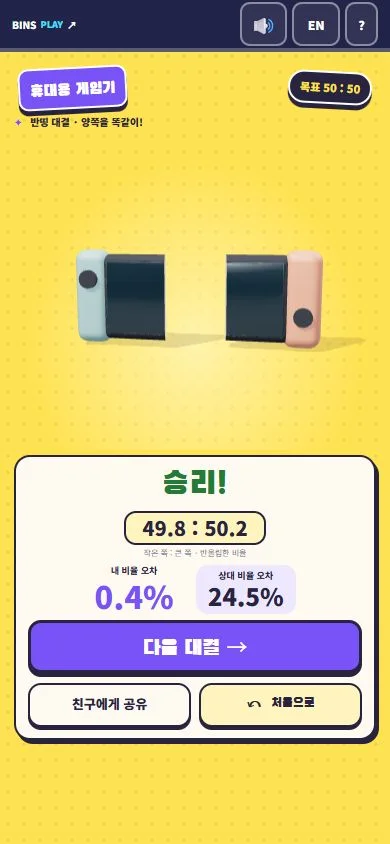
After cutting, the pieces move apart. The result shows where your line went and which side turned out larger than you expected.
Let the object and target carry the difficulty
Once straight cutting became easier, the next challenge came from asymmetric objects and uneven front-to-back thickness rather than more complicated input. Not-Half changes the target, and One-Look locks the view after five seconds.
Normal mode adds no time penalty for rotating or redrawing. Players can think before cutting, or choose the separate limited-observation mode.
Recognisable objects matter too
Dumplings, shrimp and sausages were difficult to recognise as simple geometric shapes. Curves and small surface details were revised. These remain stylised game solids, not cloth simulations or material-density weight measurements.